This posting is a quick update to announce the beginning of my new blog, Genealogy With Annie B, which will be dedicated to articles about Family History.
This blog, AnnieWritesAbout, will continue, of course!
Annie
Monday, November 13, 2017

Saturday, October 28, 2017
Onward to Bella Roma! (Sisters In Europe, Part V)
This web log is a repository for the musings of an inveterate autodidact (history, genealogy, the arts, travelogues, politics, economics, book reviews, et cetera). Civilized discourse is heartily welcome here!
A Happy Fall to You All!
It's been a couple of months since posting to this Write-About blog because we (Marty, his sister Lisa, and I) have been roaming about--specifically, in the inspirational countries of Scotland and England, spending most of our time in the countryside walking on some of the National Trails of Britain. I'll write about the adventures of this latest trip at a later time.
For this chapter of the travelogue for my sister Cynthia's 50th-birthday European expedition in 2015, I promised to share a bit of what we did in one of my home-away-from-home cities, Rome, Italy!
Getting to Rome from Edinburgh ended up being a hassle, because there was a problem with the flight we had booked. We were able to get a flight to Milan right away, but that meant taking an overnight train from Milan to Rome, which was an interesting undertaking.
For one thing, my sister had not quite grasped the idea that gypsy groups target tourists in Europe, particularly in Italy. I had broached the subject with her while we were still in the U.K., but beggars in Britain are so similar to those in the U.S. that she had no cause yet to take my warnings very seriously.
However, once we got onto the train in Milan and had settled into a compartment, where we were to try and get a little sleep, Cynthia became troubled that there were men sitting in the passageway outside the compartment that did not have a proper seat. She proceeded to invite a couple of them into our compartment, and as they entered it became apparent that these men had no luggage. They were clearly migrants and were probably refugees or gypsies. Oh, boy! Fortunately, they did not smell particularly ripe and appeared to be tired enough to want to rest. I simply indicated to my sister that she should sleep with her purse beneath her head as a pillow. Fortunately, our luggage-free compartment mates did not bother us. Whew!
We did not sleep very well during the cold and bumpy train ride, so we arrived in Rome not only 18 hours late but quite exhausted. Still, our first day in Rome was fine. Our hostel was not far from the train station, and I know the neighborhood pretty well, so we were quickly able to deliver our luggage to the hostel, drink a couple cappuccinos, and walk around for a while. Some of the most beautiful churches in Rome were right nearby, including some with breathtakingly beautiful mosaic-covered walls.
My favorite hostel in Rome, Papa Germano, was booked for our dates, so I picked an alternative in the same general area. I won't name the hostel because we were not happy with the management. Next time I stay at Papa Germano, I will be so much more grateful for their friendly, comfy accommodations!!
Cynthia's love of historical sites and old churches was very well served in Rome, of course! She seemed to appreciate very much the knowledge of the local archaeology and history that I had gained from my college studies and previous trips to Italy. It was great fun for me to show her around because her interest was so keen no matter where we went! Besides the usual "Caesar Shuffle"--the Forum, Colosseum, and Palatine Hill--as well as the Pantheon, the Spanish Steps, and other iconic sites, I took her to Ostia Antica (the ruins of Rome's old port town) and to one of my favorite Roman neighborhoods, the Trastevere. We dropped by the Trevi Fountain to toss our coins, but alas, the fountain was closed off for repairs. Bummer.
The food in Rome is legendary for its high quality, provided one steers clear of tourist traps. One of my favorite things to eat in Italy is "pizza al taglio," which is deli pizza that is cut to order, heated up, and wrapped in paper. You pay for it by weight. I like to fold the pizza over and eat it like a sandwich, as many of the locals do. It's a wonderful cheap lunch! Of course, we had some wonderful restaurant meals in Rome, along with great wine and gelato every day. Fortunately, all the walking through ruins burns the calories quickly!
Another wonderful thing about Rome is the large number of public water spigots, fed by the old aqueducts, where you can get a quick cold drink on a hot day or even fill your water bottle. The water is so refreshing and delicious!
I had never before been to the Capuchin Crypts, but Rosa and Carolynn, Cynthia's daughters, insisted I should take her there, so I figured for once I could endure the hokey, macabre weirdness of human skeleton pieces meticulously arranged into patterns, room after room. My sister found it to be interesting. To me, it is a desecration of human remains, and I refuse to visit it again.
Cynthia was blown away by Saint Peter's Basilica, and she was intent upon buying rosaries for friends back home and having them blessed in the Basilica. I told her not to buy them from shops in or near the Vatican. Instead, I took her to a terrific shop on Borgo Pio called Comandini. It is one of the few religious-goods shops in the neighborhood surrounding the Vatican where you will see as many clergy and nuns shopping as lay people. I had bought my favorite Bible cover, with a machine-embroidered face of Christ, at Comandini in 2013, and had discovered that I could buy items for my Catholic friends and family for as little as one-fourth the price as near the Vatican. After Cynthia chose some pretty rosaries, we went back to the Basilica and easily found a priest on duty who spoke English and was happy to bless them for my sister.

Because our experience on the train with the two migrant guys turned out to be so benign, it still took a bit of convincing to get Cynthia to stop engaging in conversations with street peddlers (gypsies), for whom the word "no" is still an invitation to try aggressively to sell you something. I explained to her that the beggars were mostly gypsies, too--the more pitiful they were, the more likely they were to be in business. Our visit to the Comandini shop actually helped convince her!
Beside the entrance to Comandini was a gypsy lady sitting on the ground with a bundle wrapped in a blanket that she was rocking back-and-forth like an infant. She had a money cup next to her, and as we entered the store, she mumbled, "Signora, per favore...." I took my sister inside the store, showed her around a bit, and then went out to a bench across the street to wait for her to do her shopping. As I sat on the bench, I witnessed a "changing of the guard" take place near the Comandini entrance. Another gypsy lady walked up to the seated lady with the bundle, who stood up, handed the bundle to the new lady, and walked away. The new gypsy lady sat down in the spot by the door and began her "shift" begging at Comandini! When Cynthia emerged from the store and found me on the bench, I pointed out to her that there was a different lady begging with the same bundle, and she finally believed what I had been trying to explain to her for three days!
One curious sight that Cynthia and I encountered was a "disaster drill" being conducted by the Italian Red Cross in one of the parks. Because my husband Marty is an EMT who frequently participates in such exercises here in Marin County, while we watched the scene I took a few pictures of it to share with him.


When we said "Arrivederci, Roma!" it was time to catch our flight to Paris--the subject of our next chapter of "Sisters In Europe."
Ciao, for now!
Annie
"Rome--the city of visible history, where the past of a whole hemisphere seems moving in funeral procession with strange ancestral images and trophies gathered from afar." -- George Eliot
A Happy Fall to You All!
It's been a couple of months since posting to this Write-About blog because we (Marty, his sister Lisa, and I) have been roaming about--specifically, in the inspirational countries of Scotland and England, spending most of our time in the countryside walking on some of the National Trails of Britain. I'll write about the adventures of this latest trip at a later time.
For this chapter of the travelogue for my sister Cynthia's 50th-birthday European expedition in 2015, I promised to share a bit of what we did in one of my home-away-from-home cities, Rome, Italy!
Getting to Rome from Edinburgh ended up being a hassle, because there was a problem with the flight we had booked. We were able to get a flight to Milan right away, but that meant taking an overnight train from Milan to Rome, which was an interesting undertaking.
For one thing, my sister had not quite grasped the idea that gypsy groups target tourists in Europe, particularly in Italy. I had broached the subject with her while we were still in the U.K., but beggars in Britain are so similar to those in the U.S. that she had no cause yet to take my warnings very seriously.
However, once we got onto the train in Milan and had settled into a compartment, where we were to try and get a little sleep, Cynthia became troubled that there were men sitting in the passageway outside the compartment that did not have a proper seat. She proceeded to invite a couple of them into our compartment, and as they entered it became apparent that these men had no luggage. They were clearly migrants and were probably refugees or gypsies. Oh, boy! Fortunately, they did not smell particularly ripe and appeared to be tired enough to want to rest. I simply indicated to my sister that she should sleep with her purse beneath her head as a pillow. Fortunately, our luggage-free compartment mates did not bother us. Whew!
We did not sleep very well during the cold and bumpy train ride, so we arrived in Rome not only 18 hours late but quite exhausted. Still, our first day in Rome was fine. Our hostel was not far from the train station, and I know the neighborhood pretty well, so we were quickly able to deliver our luggage to the hostel, drink a couple cappuccinos, and walk around for a while. Some of the most beautiful churches in Rome were right nearby, including some with breathtakingly beautiful mosaic-covered walls.
My favorite hostel in Rome, Papa Germano, was booked for our dates, so I picked an alternative in the same general area. I won't name the hostel because we were not happy with the management. Next time I stay at Papa Germano, I will be so much more grateful for their friendly, comfy accommodations!!
Cynthia's love of historical sites and old churches was very well served in Rome, of course! She seemed to appreciate very much the knowledge of the local archaeology and history that I had gained from my college studies and previous trips to Italy. It was great fun for me to show her around because her interest was so keen no matter where we went! Besides the usual "Caesar Shuffle"--the Forum, Colosseum, and Palatine Hill--as well as the Pantheon, the Spanish Steps, and other iconic sites, I took her to Ostia Antica (the ruins of Rome's old port town) and to one of my favorite Roman neighborhoods, the Trastevere. We dropped by the Trevi Fountain to toss our coins, but alas, the fountain was closed off for repairs. Bummer.
The food in Rome is legendary for its high quality, provided one steers clear of tourist traps. One of my favorite things to eat in Italy is "pizza al taglio," which is deli pizza that is cut to order, heated up, and wrapped in paper. You pay for it by weight. I like to fold the pizza over and eat it like a sandwich, as many of the locals do. It's a wonderful cheap lunch! Of course, we had some wonderful restaurant meals in Rome, along with great wine and gelato every day. Fortunately, all the walking through ruins burns the calories quickly!
Another wonderful thing about Rome is the large number of public water spigots, fed by the old aqueducts, where you can get a quick cold drink on a hot day or even fill your water bottle. The water is so refreshing and delicious!
I had never before been to the Capuchin Crypts, but Rosa and Carolynn, Cynthia's daughters, insisted I should take her there, so I figured for once I could endure the hokey, macabre weirdness of human skeleton pieces meticulously arranged into patterns, room after room. My sister found it to be interesting. To me, it is a desecration of human remains, and I refuse to visit it again.
Cynthia was blown away by Saint Peter's Basilica, and she was intent upon buying rosaries for friends back home and having them blessed in the Basilica. I told her not to buy them from shops in or near the Vatican. Instead, I took her to a terrific shop on Borgo Pio called Comandini. It is one of the few religious-goods shops in the neighborhood surrounding the Vatican where you will see as many clergy and nuns shopping as lay people. I had bought my favorite Bible cover, with a machine-embroidered face of Christ, at Comandini in 2013, and had discovered that I could buy items for my Catholic friends and family for as little as one-fourth the price as near the Vatican. After Cynthia chose some pretty rosaries, we went back to the Basilica and easily found a priest on duty who spoke English and was happy to bless them for my sister.

Because our experience on the train with the two migrant guys turned out to be so benign, it still took a bit of convincing to get Cynthia to stop engaging in conversations with street peddlers (gypsies), for whom the word "no" is still an invitation to try aggressively to sell you something. I explained to her that the beggars were mostly gypsies, too--the more pitiful they were, the more likely they were to be in business. Our visit to the Comandini shop actually helped convince her!
Beside the entrance to Comandini was a gypsy lady sitting on the ground with a bundle wrapped in a blanket that she was rocking back-and-forth like an infant. She had a money cup next to her, and as we entered the store, she mumbled, "Signora, per favore...." I took my sister inside the store, showed her around a bit, and then went out to a bench across the street to wait for her to do her shopping. As I sat on the bench, I witnessed a "changing of the guard" take place near the Comandini entrance. Another gypsy lady walked up to the seated lady with the bundle, who stood up, handed the bundle to the new lady, and walked away. The new gypsy lady sat down in the spot by the door and began her "shift" begging at Comandini! When Cynthia emerged from the store and found me on the bench, I pointed out to her that there was a different lady begging with the same bundle, and she finally believed what I had been trying to explain to her for three days!
One curious sight that Cynthia and I encountered was a "disaster drill" being conducted by the Italian Red Cross in one of the parks. Because my husband Marty is an EMT who frequently participates in such exercises here in Marin County, while we watched the scene I took a few pictures of it to share with him.


When we said "Arrivederci, Roma!" it was time to catch our flight to Paris--the subject of our next chapter of "Sisters In Europe."
Ciao, for now!
Annie
"Rome--the city of visible history, where the past of a whole hemisphere seems moving in funeral procession with strange ancestral images and trophies gathered from afar." -- George Eliot
Friday, August 11, 2017
Across the U.S. in Die Frau Blue Car, Part V
Aghast because it's already August, Fair Readers?
Yes, the Summer does seem to be flying by. Still pulling up springtime "volunteer" foliage from the back yard, which responded most verdantly to last Winter's torrents.
Didn't get a chance to cover it last month, but July 12th of this year was the 200th birthday of one of my favorite authors, Henry David Thoreau! This year, I did not make it to the annual gathering of The Thoreau Society (of which I am a very happy member!) in Concord, Massachusetts, where the main celebrations took place, but we did some local celebrating here in Marin County with public readings of his works at both the San Rafael Public Library and the Barnes & Noble store in Corte Madera. The United States Postal Service has issued a commemorative stamp to honor Thoreau, as well!

I did, however, attend two special Thoreauvian events last year in Concord! The first was a week-long professional-development program for teachers entitled "Approaching Walden," offered by The Walden Woods Project (I'm also a member of this wonderful group!). I had applied for this program before I knew I'd be retiring from classroom teaching and then decided to go anyway, because the annual gathering of The Thoreau Society was taking place immediately after "Approaching Walden" and I'd be in Concord, anyway. Plus, I have continued to be involved in education through other avenues. Any teachers out there who wish to add elements of environmental stewardship and social responsibility to your curricula should visit The Walden Woods Project website and apply for "Approaching Walden"! The ideas explored during the program have had an impact upon the way I approach writing and even simple things like going for walks, by providing tools that help elevate the meditative nature of what I am doing, regardless of context.

Following that wonderful week with The Walden Woods Project, I had the joy of exploring even more perspectives upon Henry's writings and philosophies with the annual gathering of The Thoreau Society. While I was teaching American History, one of my favorite units to present was on the Transcendentalists of the antebellum period, because they believed so strongly in freedom of spirit and conscience.
Sometimes it exasperates me that we still have to fight so hard for our God-given right to personal sovereignty, but we have been amply warned about this battle for our souls. Thomas Jefferson said that "The price of liberty is eternal vigilance," and the Bible quotes Jesus as having stated, "From the days of John the Baptist until now the Kingdom of Heaven has suffered violence, and men of violence take it by force" (Matthew 11:12, RSV). Our desire for both liberty on Earth and citizenship in the Heavenly Kingdom are tied inextricably to our free will. If such warfare is unavoidable, I'm content to continue waging it with gusto, chiefly with the support of our church community, but also welcoming the inspiration of family and friends, Thoreauvian or not, with whom I have so many exhilarating exchanges.
Any of you who have not yet visited Concord, Massachusetts are in for a very unique experience when you do! I recommend taking at least three days to visit the town that brought us not only Henry Thoreau but Ralph Waldo Emerson, Nathaniel Hawthorne, and Louisa May Alcott. Many historic dwellings there have been preserved, including the homes of Emerson and Alcott, and you can visit the serene Walden Pond, the site of Thoreau's home in the woods, and the beautiful Sleepy Hollow Cemetery, where they are all buried on Author's Ridge. If you are fortunate, you will meet the two wonderful gentlemen who provide marvelous portrayals Thoreau and Hawthorne!
Just sitting here writing this, I can hardly wait to go back and see my Concord friends!
When next you travel with me "Across the U.S. in Die Frau Blue Car," I will take you on a visit to a few more places that are important to my family's history--Morristown, NJ, Staten Island, and Rhode Island!
Annie
Wealth is the ability to fully experience life." -- Henry David Thoreau
Yes, the Summer does seem to be flying by. Still pulling up springtime "volunteer" foliage from the back yard, which responded most verdantly to last Winter's torrents.
Didn't get a chance to cover it last month, but July 12th of this year was the 200th birthday of one of my favorite authors, Henry David Thoreau! This year, I did not make it to the annual gathering of The Thoreau Society (of which I am a very happy member!) in Concord, Massachusetts, where the main celebrations took place, but we did some local celebrating here in Marin County with public readings of his works at both the San Rafael Public Library and the Barnes & Noble store in Corte Madera. The United States Postal Service has issued a commemorative stamp to honor Thoreau, as well!
I did, however, attend two special Thoreauvian events last year in Concord! The first was a week-long professional-development program for teachers entitled "Approaching Walden," offered by The Walden Woods Project (I'm also a member of this wonderful group!). I had applied for this program before I knew I'd be retiring from classroom teaching and then decided to go anyway, because the annual gathering of The Thoreau Society was taking place immediately after "Approaching Walden" and I'd be in Concord, anyway. Plus, I have continued to be involved in education through other avenues. Any teachers out there who wish to add elements of environmental stewardship and social responsibility to your curricula should visit The Walden Woods Project website and apply for "Approaching Walden"! The ideas explored during the program have had an impact upon the way I approach writing and even simple things like going for walks, by providing tools that help elevate the meditative nature of what I am doing, regardless of context.
Following that wonderful week with The Walden Woods Project, I had the joy of exploring even more perspectives upon Henry's writings and philosophies with the annual gathering of The Thoreau Society. While I was teaching American History, one of my favorite units to present was on the Transcendentalists of the antebellum period, because they believed so strongly in freedom of spirit and conscience.
Sometimes it exasperates me that we still have to fight so hard for our God-given right to personal sovereignty, but we have been amply warned about this battle for our souls. Thomas Jefferson said that "The price of liberty is eternal vigilance," and the Bible quotes Jesus as having stated, "From the days of John the Baptist until now the Kingdom of Heaven has suffered violence, and men of violence take it by force" (Matthew 11:12, RSV). Our desire for both liberty on Earth and citizenship in the Heavenly Kingdom are tied inextricably to our free will. If such warfare is unavoidable, I'm content to continue waging it with gusto, chiefly with the support of our church community, but also welcoming the inspiration of family and friends, Thoreauvian or not, with whom I have so many exhilarating exchanges.
Any of you who have not yet visited Concord, Massachusetts are in for a very unique experience when you do! I recommend taking at least three days to visit the town that brought us not only Henry Thoreau but Ralph Waldo Emerson, Nathaniel Hawthorne, and Louisa May Alcott. Many historic dwellings there have been preserved, including the homes of Emerson and Alcott, and you can visit the serene Walden Pond, the site of Thoreau's home in the woods, and the beautiful Sleepy Hollow Cemetery, where they are all buried on Author's Ridge. If you are fortunate, you will meet the two wonderful gentlemen who provide marvelous portrayals Thoreau and Hawthorne!
Just sitting here writing this, I can hardly wait to go back and see my Concord friends!
When next you travel with me "Across the U.S. in Die Frau Blue Car," I will take you on a visit to a few more places that are important to my family's history--Morristown, NJ, Staten Island, and Rhode Island!
Annie
Wealth is the ability to fully experience life." -- Henry David Thoreau
Monday, July 17, 2017
Recent Adventures on the Musical Stage and at the Political Circus
Happy Summertime, Fair Readers!
Sorry to have been rather incommunicado over the last two months! It has been my joy over that period to have been busy in rehearsals for a production of The Pajama Game with the relatively new Marin Musical Theatre Company. The last time I performed in a musical was about 1990, while still living in Los Angeles, and I'd forgotten how much fun it is to sing, dance, and ham it up in a musical. An added benefit of this production has been the immense pleasure of working with some very lovely people, who also happen to be our neighbors here in Marin County! We opened last weekend and have three more performances next weekend.
 The Pajama Game is set in a pajama factory in Iowa in the 1950s, with a sweet love story that revolves around a dispute between the management and workers at the factory. It is an interesting coincidence that, during a recent coffee hour with some of my local political-activist friends, a rather temperate discussion arose regarding the pros and cons of labor unions, although we had not been discussing the plot of the musical.
Those who attend our coffee gatherings like to focus upon local politics, but a wide variety of topics are usually raised. Our discussions are always respectful, even when they get a bit heated. My preference for objectivity that grants validity to any honestly-held viewpoint tends to goad members of the group who take a more dogmatic approach, but still my opinions are requested when we meet. Thankfully, diplomacy is not dead, even during discourse fueled by caffeine!
My own politics are Christian Libertarian, which means that I advocate for minimal government involvement in the daily lives of citizens, economic markets that are as free and fair as possible, a strong national defense that does not double as an international police force, the freedom of religious people to worship and perform charitable works, and the protection of all human life from conception to natural death. I do not vote along any strict party line, preferring to weigh each candidate and issue against my core values and vote either for the best option (ideally) or the lesser evil (unfortunately the usual choice).
As with most American political topics, I find it impossible to be absolutely for or against labor unions. There have been instances in which workers have been abused and could only find relief through union advocacy. As well, union over-reach (greed) has wreaked havoc upon some companies and industries. Often, there are clear advantages, for both industry and labor, to have unions negotiating contracts and managing benefits for employees, particularly when workers in an industry are necessarily migratory. An excellent example of this is the entertainment industry, in which most of the workers are employed by many different production companies during their careers, such that their unions can provide them with relative stability in earnings and benefits.
It is no wonder, then, that a Broadway musical and Hollywood film like The Pajama Game would take a pro-union stance. As someone who benefits from her spouse's labor union (Marty is a member of the International Alliance of Theatrical Stage Employees, Moving Picture Technicians, Artists and Allied Crafts, or I.A.T.S.E., Local 16), how could I have a problem with that?
Okay, enough politics for the time being. In my next posting, I'll get back to recounting recent travel adventures.
Annie
"Work hard, be kind, and amazing things will happen." -- Conan O'Brien
Sorry to have been rather incommunicado over the last two months! It has been my joy over that period to have been busy in rehearsals for a production of The Pajama Game with the relatively new Marin Musical Theatre Company. The last time I performed in a musical was about 1990, while still living in Los Angeles, and I'd forgotten how much fun it is to sing, dance, and ham it up in a musical. An added benefit of this production has been the immense pleasure of working with some very lovely people, who also happen to be our neighbors here in Marin County! We opened last weekend and have three more performances next weekend.

Those who attend our coffee gatherings like to focus upon local politics, but a wide variety of topics are usually raised. Our discussions are always respectful, even when they get a bit heated. My preference for objectivity that grants validity to any honestly-held viewpoint tends to goad members of the group who take a more dogmatic approach, but still my opinions are requested when we meet. Thankfully, diplomacy is not dead, even during discourse fueled by caffeine!
My own politics are Christian Libertarian, which means that I advocate for minimal government involvement in the daily lives of citizens, economic markets that are as free and fair as possible, a strong national defense that does not double as an international police force, the freedom of religious people to worship and perform charitable works, and the protection of all human life from conception to natural death. I do not vote along any strict party line, preferring to weigh each candidate and issue against my core values and vote either for the best option (ideally) or the lesser evil (unfortunately the usual choice).
As with most American political topics, I find it impossible to be absolutely for or against labor unions. There have been instances in which workers have been abused and could only find relief through union advocacy. As well, union over-reach (greed) has wreaked havoc upon some companies and industries. Often, there are clear advantages, for both industry and labor, to have unions negotiating contracts and managing benefits for employees, particularly when workers in an industry are necessarily migratory. An excellent example of this is the entertainment industry, in which most of the workers are employed by many different production companies during their careers, such that their unions can provide them with relative stability in earnings and benefits.
It is no wonder, then, that a Broadway musical and Hollywood film like The Pajama Game would take a pro-union stance. As someone who benefits from her spouse's labor union (Marty is a member of the International Alliance of Theatrical Stage Employees, Moving Picture Technicians, Artists and Allied Crafts, or I.A.T.S.E., Local 16), how could I have a problem with that?
Okay, enough politics for the time being. In my next posting, I'll get back to recounting recent travel adventures.
Annie
"Work hard, be kind, and amazing things will happen." -- Conan O'Brien
Thursday, May 11, 2017
Enchanting Edinburgh (Sisters in Europe, Part IV)
Our train from Manchester, England to Edinburgh, Scotland was diverted to Glasgow, so we were delayed in our arrival, but the scenery (lovely green hills and lots of sheep) was pleasant, and we were upgraded to first class on the train from Glasgow to Edinburgh. The Scottish branch of our family is from the Glasgow area, and I'd definitely like to visit there (possibly this year!), but Cynthia's daughters urged me to take her to see Edinburgh and especially its glorious Castle.
We stayed in the very friendly and spacious Castle Rock Hostel. The atmosphere at Castle Rock did a lot to set the mood for a wonderful time in Edinburgh. Here is my favorite of their common areas:


It is likely you are all aware of some of the rich history of Edinburgh, including the role its thinkers played in the Scottish Enlightenment that fed modern ideas into the minds of the American Founding Fathers, as they devised a government for our new country in the 18th century. One of the most important thinkers of that time was the philosopher and economist Adam Smith. Cynthia and I were taking a walk through one of the eerily beautiful cemeteries in Edinburgh when she saw me get really, really excited. Why? Because I had happened upon the gated tomb of Adam Smith! I have studied and taught economics, and he is one of my heroes. I did not know when we entered that cemetery that we would find him there.


The main street in the old section of Edinburgh is called The Royal Mile, leading to the Scottish House of Parliament, Her Majesty's local residence called Holyrood Palace, and of course the astoundingly beautiful Edinburgh Castle. Here is a photo I snapped of one of the Castle courtyards. Makes you want to go there, doesn't it?
 Anyone who knows Cynthia is aware of her love for canine companions (I like doggies, too!), so we enjoyed seeing this lovingly manicured dog cemetery in the Castle:


Also prominent along The Royal Mile is the magnificent Saint Giles Cathedral. Cynthia and I toured it, church mice that we are, and we managed to get a chance to enter its Chapel of the Order of the Thistle.

As historic as The Royal Mile is, there is plenty of room for modern convenience. In this age of mobile phones, it's nice that a use has been found for the iconic red telephone boxes.

We had hoped to visit Holyrood Palace, but it was closed because Her Majesty was set to arrive. We did take the bus ride out to tour the Royal Yacht Britannia. It is an elegant and cozy boat and, upon taking the excellent tour of her, it is easy to get a sense of why Queen Elizabeth loved to spend time aboard Britannia. After the tour, we had a refreshing snack in their gorgeous tea room.
Cynthia and I left Edinburgh the day before Her Majesty was scheduled to arrive. We're bummed that we did not get to see her, but we were treated to the rehearsal for her arrival ceremony, complete with a kilted marching band playing bagpipes, which was one of the highlights of our visit.
When next you join us for our European adventures, dear readers, we will be in Rome, the Eternal City!
Annie
"The real tragedy of the poor is the poverty of their aspirations." -- Adam Smith
We stayed in the very friendly and spacious Castle Rock Hostel. The atmosphere at Castle Rock did a lot to set the mood for a wonderful time in Edinburgh. Here is my favorite of their common areas:

And this stairwell helps create their "castle" vibe.

It is likely you are all aware of some of the rich history of Edinburgh, including the role its thinkers played in the Scottish Enlightenment that fed modern ideas into the minds of the American Founding Fathers, as they devised a government for our new country in the 18th century. One of the most important thinkers of that time was the philosopher and economist Adam Smith. Cynthia and I were taking a walk through one of the eerily beautiful cemeteries in Edinburgh when she saw me get really, really excited. Why? Because I had happened upon the gated tomb of Adam Smith! I have studied and taught economics, and he is one of my heroes. I did not know when we entered that cemetery that we would find him there.

Of course, I had to pose at Adam Smith's very dignified and
well-cared-for tomb.

The main street in the old section of Edinburgh is called The Royal Mile, leading to the Scottish House of Parliament, Her Majesty's local residence called Holyrood Palace, and of course the astoundingly beautiful Edinburgh Castle. Here is a photo I snapped of one of the Castle courtyards. Makes you want to go there, doesn't it?


Also prominent along The Royal Mile is the magnificent Saint Giles Cathedral. Cynthia and I toured it, church mice that we are, and we managed to get a chance to enter its Chapel of the Order of the Thistle.

As historic as The Royal Mile is, there is plenty of room for modern convenience. In this age of mobile phones, it's nice that a use has been found for the iconic red telephone boxes.

We had hoped to visit Holyrood Palace, but it was closed because Her Majesty was set to arrive. We did take the bus ride out to tour the Royal Yacht Britannia. It is an elegant and cozy boat and, upon taking the excellent tour of her, it is easy to get a sense of why Queen Elizabeth loved to spend time aboard Britannia. After the tour, we had a refreshing snack in their gorgeous tea room.
Cynthia and I left Edinburgh the day before Her Majesty was scheduled to arrive. We're bummed that we did not get to see her, but we were treated to the rehearsal for her arrival ceremony, complete with a kilted marching band playing bagpipes, which was one of the highlights of our visit.
When next you join us for our European adventures, dear readers, we will be in Rome, the Eternal City!
Annie
"The real tragedy of the poor is the poverty of their aspirations." -- Adam Smith
Sunday, March 26, 2017
Across the U.S. in Die Frau Blue Car, Part IV
Generally, if I'm in Virginia, I want to hang around for a while, because it's one of my favorite states (anyone interested in American history will find lots to love in Virginia!). However, it was not too hard to force myself away in order to spend a few days in one of my favorite cities, New York, with the intention of taking in a couple of Broadway shows and enjoying a New York Fourth of July.
In the past, I have always stayed in the Upper West Side of Manhattan while in NYC, but this time I wanted to try having Brooklyn as home-base, especially since I needed a place to park Die Frau and I'd rather not drive in Manhattan, anyway. I was in luck! I found a hostel in Brooklyn that had street parking and sounded good from the online reviews, so I booked myself into the Moore Hostel in the East Williamsburg section of Brooklyn.

Moore Hostel in East Williamsburg, Brooklyn
On my way into Brooklyn, I had to go through the Holland Tunnel, which had a $15 toll(!!). Then I had to take a not-too-awful drive through Lower Manhattan and across the Williamsburg Bridge.
The dorm room in which I stayed at Moore Hostel was much more spacious than one usually finds at a hostel. It was nice not to be in a bunk bed, too. The staff at the hostel was terrific, and there was plenty of kitchen space and a nice lounge area. I'd definitely stay there again! It was easy to park Die Frau on the same block, but I misread one of the parking signs and ended up with a ticket. Oh, well.

My dorm in the Moore Hostel.
Moore Hostel is in an industrial area and across the street from a place that looks like a salvage business, but the street was very quiet at night. The hostel is near the subway and a library (yay!).
Besides my usual walk through Central Park and people-watching at Bryant Park, I looked for some shows to see. Four times, I entered the ticket lottery for Hamilton but struck out each time. As a consolation, I caught a haunting production of The Crucible directed by Ivo Van Hove and starring Saoirse Ronan and Ciaran Hinds. After such a serious, but wonderful, production I had to see something lighter, so I opted for the musical Waitress with the astoundingly terrific Jessie Mueller--another excellent show!

The magnificent Jessie Mueller in Waitress, on Broadway.
Still bummed about not seeing Hamilton, though. The U.S. tour of Hamilton is currently in San Francisco, so I've been entering the ticket lottery for that production, but I'd eventually like to see their London production!
The night before leaving New York, I had the tremendous joy of watching the Macy's Independence Day fireworks from Brooklyn. It was raining that evening, and as we all waited and hoped for a break in the storm to see the show, people were huddling under pizza boxes as well as umbrellas. A few people left, but those of us who stayed were glad we did. I did not mind getting wet. It was such a special night. Marty was at dance camp in California and also having a good time, but having him there too would have been extra fun.
The night before leaving New York, I had the tremendous joy of watching the Macy's Independence Day fireworks from Brooklyn. It was raining that evening, and as we all waited and hoped for a break in the storm to see the show, people were huddling under pizza boxes as well as umbrellas. A few people left, but those of us who stayed were glad we did. I did not mind getting wet. It was such a special night. Marty was at dance camp in California and also having a good time, but having him there too would have been extra fun.
The next time I take you on the American road with me via this web log, we will be in beautiful, historic Concord, Massachusetts!
Annie
"I speak my own sins; I cannot judge another. I have no tongue for it."
-- Arthur Miller, from The Crucible.
-- Arthur Miller, from The Crucible.
Thursday, January 26, 2017
Manchester Meanderings (Sisters In Europe, Part III)
Before I begin chatting about wonderful Manchester, I must conclude my comments about Bath. The town is blatantly tourist-y but it still has an engaging history and quite a bit of charm.
We toured the ruins of the Roman baths, which are indeed fascinating, although they have been too adulterated (i.e., redecorated) over the years to rank high on my list of worthwhile Classical attractions. We enjoyed the guided tour very much and took a few generous swallows of the water from the geothermal spring that still runs at the site. I would have enjoyed bathing in the warm waters, but the bathing areas are so commercialized that we were turned off by them. (No doubt, we are spoiled by the simple, rustic, inexpensive and/or free hot-spring pools that we enjoy in the mountains of California!)


From Bath, Cynthia and I rode a train to the hard-working city of Manchester, which had been the home of our paternal grandmother, Mary Jane O'Brien. We called her Grandma Jenny. Her parents' families were from Ireland--County Mayo and County Roscommon--but they had been in western England since the mid-19th century. Grandma Jenny was born in Manchester in 1904 and lived in the same general area until moving to America in 1920.
One of the most striking characteristics of Manchester is its wonderful lack of tourists. Certainly, there is a lot to see in Manchester, including two major teams and stadiums for football (that's "soccer" in Yank-speak), a football museum, and of course art, history, and science museums, plus a zoo.
We toured the ruins of the Roman baths, which are indeed fascinating, although they have been too adulterated (i.e., redecorated) over the years to rank high on my list of worthwhile Classical attractions. We enjoyed the guided tour very much and took a few generous swallows of the water from the geothermal spring that still runs at the site. I would have enjoyed bathing in the warm waters, but the bathing areas are so commercialized that we were turned off by them. (No doubt, we are spoiled by the simple, rustic, inexpensive and/or free hot-spring pools that we enjoy in the mountains of California!)

The main pool at the Roman Baths of Bath.
I was most impressed with the gorgeous and majestic Bath Abbey. As you can see by the photo, its Gothic architecture is marvelously intricate. My favorite artifact of Bath Abbey is the carved Jacob's Ladder flanking the doorways in the front. So unique and engaging!

The Bath Abbey and courtyard (above)
and Jacob's Ladder from its façade (below).
From Bath, Cynthia and I rode a train to the hard-working city of Manchester, which had been the home of our paternal grandmother, Mary Jane O'Brien. We called her Grandma Jenny. Her parents' families were from Ireland--County Mayo and County Roscommon--but they had been in western England since the mid-19th century. Grandma Jenny was born in Manchester in 1904 and lived in the same general area until moving to America in 1920.
One of the most striking characteristics of Manchester is its wonderful lack of tourists. Certainly, there is a lot to see in Manchester, including two major teams and stadiums for football (that's "soccer" in Yank-speak), a football museum, and of course art, history, and science museums, plus a zoo.
Cynthia and I enjoyed taking in the bustling local work-a-day color of the place. So many nice people! The joy of getting to know Manchester and its people can be somewhat illustrated by the purple, leather-jacketed, rebelliously no-nonsense character, pictured below, that appeared all over the city to advertise for a mobile-phone service.

Of course, church mice like us had to spend time exploring the beautiful neo-Gothic Manchester Cathedral, which had been damaged during the Blitz in 1940 but has been lovingly repaired, complete with a very reverent section dedicated to those who served in the war.

The grounds of the Cathedral include a lovely garden and play yard with a whimsical teeter-totter that we simply had to try out!


Of course, church mice like us had to spend time exploring the beautiful neo-Gothic Manchester Cathedral, which had been damaged during the Blitz in 1940 but has been lovingly repaired, complete with a very reverent section dedicated to those who served in the war.

Manchester Cathedral.
The grounds of the Cathedral include a lovely garden and play yard with a whimsical teeter-totter that we simply had to try out!


Our only disappointment in Manchester was learning that the archives at the beautiful Victorian Gothic John Rylands Library was not especially useful for our genealogical research, because it contained nothing that we could not access via the Family History Library in Salt Lake City, Utah. In fact, the librarians at Rylands do such research themselves through the Utah library! Still, the Rylands Library is a lovely place, and next time I will endeavor to enjoy what it actually has, rather than grouse about what it does not have.

The Reading Room at the John Rylands Library.
Fortunately, I had collected enough advance information about our grandmother's old neighborhood that Cynthia and I were able to have a particularly good time exploring it, including a very friendly pub named Bullock Smithy(!). Details about Grandma Jenny's life in Manchester will be the subject of a future posting.


A treasured photo of Grandma Jenny, seated on the left, and her sister Margaret, taken in 1920, the year they left England.
The nerd in me had to visit the august University of Manchester, where there is a wonderful park-bench sculpture of the famous cryptologist Alan Turing, whose work in decoding Nazi messages was instrumental in helping the Allies win the war in Europe. We found piles of flower bouquets on Dr. Turing's statue! Good to see he has lots of fans, including me! (Apologies for my squinty eyes in this photo. My small eyes close up in bright light 😎.)

Our "recon" mission in Manchester was satisfying enough that I'm hoping to visit there again before too long, likely for more family research. When Cynthia and I left Manchester, we hopped aboard another train bound for Edinburgh, Scotland!
Annie
"Machines take me by surprise with great frequency" -- Alan Turing.
Saturday, December 31, 2016
An Invitation to Join "2017 -- The Year of Kindness"!!!
My Dear Family and Friends:
It is my great joy to begin promoting the idea of making 2017 "The Year of Kindness." I've been reading and hearing many in media circles discussing the phenomenon that people in America have grown so tired of mean-spirited politics and social strife, that a movement is emerging among average Americans to give deliberate acts of kindness greater-than-average importance in the coming year. I'm all for that! Let us all promote this Kindness Movement, beginning with our New Year's celebrations!!!
Wishing you all a very blessed 2017,
Annie
"A good deed is never lost; he who sows courtesy reaps friendship, and he who plants kindness gathers love." -- Saint Basil the Great of Caesarea
Thursday, December 22, 2016
Across the U.S. in Die Frau Blue Car, Part III
Before we all head full-on into the Christmas and New-Year holidays, here is a brief report about my visit last June to Prickett's Fort State Park in Fairmont, West Virginia.

Captain Jacob Prickett is a direct ancestor of ours, via my mother's family. The Pricketts were early settlers in the western frontier of Virginia that would later become the state of West Virginia. These adventurous settlers braved harsh, rustic conditions and engaged mostly in farming and trade. Captain Prickett served for many years with the Virginia Militia and had fought in the French and Indian War with George Washington at Fort Necessity. As a young man, Prickett had accompanied Lawrence Washington (brother of George) in scouting local lands. Prickett also took part in the Revolutionary War.


Captain Prickett and his two brothers had a fort constructed in 1774 near the Monongahela River as a means of sheltering his family, and the families of many neighbors, from attacks by the Shawnee and other local Indians. The original fort no longer exists, but the fort's cemetery remains, and the site is preserved as a state park, with a model frontier fort and some wonderful living-history docents who provide explanations and demonstrations that do a wonderful job of transporting the imaginations of visitors into the rigors and dangers of frontier life. I highly recommend a visit to Prickett's Fort State Park to anyone who finds themselves in West Virginia!


The visitor's center at the fort has a wonderful library, and the staff allowed me to comb through some of its books and take notes for my genealogical studies. I'm looking forward to return visits to this wonderful site, hopefully accompanied by family members!
Annie
"Christmas is a season not only of rejoicing but of reflection." -- Winston Churchill

Captain Jacob Prickett is a direct ancestor of ours, via my mother's family. The Pricketts were early settlers in the western frontier of Virginia that would later become the state of West Virginia. These adventurous settlers braved harsh, rustic conditions and engaged mostly in farming and trade. Captain Prickett served for many years with the Virginia Militia and had fought in the French and Indian War with George Washington at Fort Necessity. As a young man, Prickett had accompanied Lawrence Washington (brother of George) in scouting local lands. Prickett also took part in the Revolutionary War.

The cemetery at Prickett's Fort

The cemetery monument for Captain Prickett and his wife Dorothy

Some views of the model fort

from the website of

the Prickett's Fort Memorial Foundation

Some dedicated living-history docents

at Prickett's Fort

Annie
"Christmas is a season not only of rejoicing but of reflection." -- Winston Churchill
Friday, November 18, 2016
Book Review -- "Walking to Canterbury" by Jerry Ellis.
While on our annual family outing in the Eastern Sierras for Aida's birthday, during which we inhabited a cabin at Virginia Lakes that is owned by some very kind friends, my sister-in-law Lisa and I were so exhilarated by the local trails that we decided we would like to take a trip to Britain next year to go walk-a-bout. Combing the San Francisco Main Library for books to help us plan such UK outing, I happened upon a book in the travel-writing section with an intriguing title -- "Walking to Canterbury: A Modern Journey Through Chaucer's Medieval England." The title piqued my interest, as it seemed likely that the book's contents would provide a few ideas for our own trek. More than just ideas, this book provided ample inspiration!
Author Jerry Ellis is well known for taking very long walks and then writing beautifully about them. He explains in "Walking to Canterbury" that he has ancestral roots in the British Isles and also some Cherokee blood. Ellis had previously undertaken a journey across the Trail of Tears, that had been the route of the forced Cherokee exodus from their homeland at the direction of our government in the 1830s. He had written about this extensive hike in his celebrated book entitled "Walking the Trail" (which is now on my reading list). Ellis felt behooved to embark upon a pilgrimage in the UK that would in some ways mirror his expedition in honor of the Cherokee.
Ellis recounts his experiences as he walked along the medieval Pilgrim's Way to Canterbury, which he began not far outside London and concluded about a week later at Canterbury Cathedral, the site of the brutal murder/martyrdom of Thomas Becket. He alternates his physical and spiritual adventures along the trail with fascinating studies, both of life in medieval England and the troubled pilgrims described in Chaucer's Canterbury Tales. Ellis finds himself sympathizing, and sometimes identifying, with the medieval pilgrims, and he describes his strong, reliant affection for the colorful characters with whom he interacts during his week in 1999 England.
In the book's Epilogue, Ellis offers some of the perspective to be gained from a look back at medieval Britain: "While the medieval church may have controlled the ignorant masses, the modern American world is also a bit brainwashed. But instead of the church doing it on the great scale it once celebrated, it has been replaced with advertisements on TV: every other ad caters to people's fear of death, just as profound now as it was in the Middle Ages. But instead of taking pilgrimages for our spiritual and physical health, we have turned to 'miracles' in the form of every pill imaginable. Don't forget to buy that new car, the latest fashion, and diet food--guaranteed to give heaven on earth."
"Walking to Canterbury" is an engrossing book for anyone who enjoys purposeful, explorational walks that immerse the sojourner in nature, history, and culture as well as provide encounters with interesting people. Ellis' approach to his own genealogical background has provided inspiration for my own efforts at compiling family history, and I believe others who have ancestral roots in Britain will find this book valuable. Ellis has likely motivated many of his readers to undertake at least small sections of the walks about which he has written, particularly this one in England because the UK government marks and preserves the trail.
The modern official British National Trail name for the Pilgrim's Way described by Chaucer is the North Downs Way. Sections of the original trail are no longer accessible, but North Downs retraces as much of the medieval route as possible, and locals still call it Pilgrim's Way.
A very blessed Thanksgiving to you all! May you feast upon the warmth of family and drink deeply of the knowledge that they love you as you are!!
Annie
"Just as our forefathers came to America to seek a better life, I grasped more clearly in digesting my trek to Canterbury that we are still searching for meaning and purpose in a complex and constantly changing society." -- Jerry Ellis
Author Jerry Ellis is well known for taking very long walks and then writing beautifully about them. He explains in "Walking to Canterbury" that he has ancestral roots in the British Isles and also some Cherokee blood. Ellis had previously undertaken a journey across the Trail of Tears, that had been the route of the forced Cherokee exodus from their homeland at the direction of our government in the 1830s. He had written about this extensive hike in his celebrated book entitled "Walking the Trail" (which is now on my reading list). Ellis felt behooved to embark upon a pilgrimage in the UK that would in some ways mirror his expedition in honor of the Cherokee.
Ellis recounts his experiences as he walked along the medieval Pilgrim's Way to Canterbury, which he began not far outside London and concluded about a week later at Canterbury Cathedral, the site of the brutal murder/martyrdom of Thomas Becket. He alternates his physical and spiritual adventures along the trail with fascinating studies, both of life in medieval England and the troubled pilgrims described in Chaucer's Canterbury Tales. Ellis finds himself sympathizing, and sometimes identifying, with the medieval pilgrims, and he describes his strong, reliant affection for the colorful characters with whom he interacts during his week in 1999 England.
In the book's Epilogue, Ellis offers some of the perspective to be gained from a look back at medieval Britain: "While the medieval church may have controlled the ignorant masses, the modern American world is also a bit brainwashed. But instead of the church doing it on the great scale it once celebrated, it has been replaced with advertisements on TV: every other ad caters to people's fear of death, just as profound now as it was in the Middle Ages. But instead of taking pilgrimages for our spiritual and physical health, we have turned to 'miracles' in the form of every pill imaginable. Don't forget to buy that new car, the latest fashion, and diet food--guaranteed to give heaven on earth."
"Walking to Canterbury" is an engrossing book for anyone who enjoys purposeful, explorational walks that immerse the sojourner in nature, history, and culture as well as provide encounters with interesting people. Ellis' approach to his own genealogical background has provided inspiration for my own efforts at compiling family history, and I believe others who have ancestral roots in Britain will find this book valuable. Ellis has likely motivated many of his readers to undertake at least small sections of the walks about which he has written, particularly this one in England because the UK government marks and preserves the trail.
The modern official British National Trail name for the Pilgrim's Way described by Chaucer is the North Downs Way. Sections of the original trail are no longer accessible, but North Downs retraces as much of the medieval route as possible, and locals still call it Pilgrim's Way.
A very blessed Thanksgiving to you all! May you feast upon the warmth of family and drink deeply of the knowledge that they love you as you are!!
Annie
"Just as our forefathers came to America to seek a better life, I grasped more clearly in digesting my trek to Canterbury that we are still searching for meaning and purpose in a complex and constantly changing society." -- Jerry Ellis
Wednesday, November 16, 2016
A Quick Request From A Simple Patriot.
Dear Friends,
More than a week has passed.
Although I acknowledge that the freedom to wage protest is sacred to all patriotic Americans, I feel the current crop of discontents who rail over the election of Trump to the presidency is not allowing themselves to appreciate an essential element of the American public arena -- the sheer power that is manifest by means of the constant atmosphere of rivalry that fills the lungs of every thinking American.
This rivalry has kept our brains oxygenated since our days as colonial subjects. This element of the American mind has changed little over three centuries, save for the fluctuations of contemporary circumstances. The genius of the very Constitution by which we govern ourselves is that it is, itself, the product of profound disagreement.
Every election, especially the federal ones, are a toss of the coin of public opinion. Particularly in the cases of the presidency and the partisan makeup of Congress, the heads and tails of this coin have taken fairly even turns throughout our history. If one side gives in to histrionics when the other side wins, they are cheating themselves of the comfort they should take in the likelihood that the next coin toss will favor their side.
This back-and-forth lob of primacy in our political structure keeps everyone in the game, always training for the next contest. If you must cry over a loss, make it a brief sniffle, then get back to work.
God bless America!
Annie
"I never considered a difference of opinion in politics, in religion, in philosophy, as cause for withdrawing from a friend." -- Thomas Jefferson
More than a week has passed.
Although I acknowledge that the freedom to wage protest is sacred to all patriotic Americans, I feel the current crop of discontents who rail over the election of Trump to the presidency is not allowing themselves to appreciate an essential element of the American public arena -- the sheer power that is manifest by means of the constant atmosphere of rivalry that fills the lungs of every thinking American.
This rivalry has kept our brains oxygenated since our days as colonial subjects. This element of the American mind has changed little over three centuries, save for the fluctuations of contemporary circumstances. The genius of the very Constitution by which we govern ourselves is that it is, itself, the product of profound disagreement.
Every election, especially the federal ones, are a toss of the coin of public opinion. Particularly in the cases of the presidency and the partisan makeup of Congress, the heads and tails of this coin have taken fairly even turns throughout our history. If one side gives in to histrionics when the other side wins, they are cheating themselves of the comfort they should take in the likelihood that the next coin toss will favor their side.
This back-and-forth lob of primacy in our political structure keeps everyone in the game, always training for the next contest. If you must cry over a loss, make it a brief sniffle, then get back to work.
God bless America!
Annie
"I never considered a difference of opinion in politics, in religion, in philosophy, as cause for withdrawing from a friend." -- Thomas Jefferson
Monday, November 7, 2016
Across the U.S. in Die Frau Blue Car, Part II
Hello, everyone!
Just got released from jury duty -- again! Is it possible I have inherited my mother's unacceptability for juries? Over and over, she was rejected to serve on juries because the attorneys thought she would be biased, due to the fact that she was a mother (the "lioness" type) and a working woman (the "no-nonsense" type). Was she really biased? Probably! But still she would have tried to be fair. Oh, well, they will keep calling me up, so perhaps I'll get my chance.
When last I was recounting my Summer vehicular sojourn, I was departing Texas and heading to New Orleans. I hadn't been there for several years, since before Hurricane Katrina. As a fan of traditional jazz music and of southern culture in general, I made it a point to spend a day in Nola. The strong French background in my family leads me to enjoy the Francophile vibe in Louisiana, although the French who settled there were mostly Catholic, while we are descended from persecuted Huguenot Protestants.
Regardless, I don't believe my Huguenot ancestors would have minded that I made my usual stop in Saint Louis Cathedral to take a look at their gorgeous ceiling.

For the first time, I wandered a over to the Old Ursuline Convent for a tour of its French Colonial building and gardens. The Ursuline nuns have had a presence in New Orleans since the 18th Century, caring for the poor and educating local girls. Their chapel has a serene feel with lots of lovely art.

New Orleans is one of the few places where I will enthusiastically stop and listen to street musicians and put more than just pocket change into their instrument cases. These are not your typical buskers! Some of the most soulful jazz you will hear is played outside of the clubs, in the open air, in New Orleans. My meanderings around the French Quarter on this trip were, as usual, a treat for the ears!
Oh, yes, and a treat for the taste buds! Can't visit Nola and not indulge in some seafood (this time, yummy catfish) and beignets from Café Du Monde (Marty made me promise to have one for him)!

À bientôt, Mes Amis!
Annie
“Always vote for principle, though you may vote alone, and you may cherish the sweetest reflection that your vote is never lost.” – John Quincy Adams
Tuesday, October 18, 2016
Friendly Hostelling in the UK (Sisters In Europe, Part II)
Hope you are all enjoying the cooler, yet cozier, days of Autumn! If you have never before traveled to Europe, may I recommend that you make your first trip there in the Autumn? My first journey to England was taken during a September in the late 1980s, and I was treated to minimal rain and relatively small crowds at even the most popular sites. The Spring is nice, too, but you are more likely to have a wet (albeit still pleasant) visit during those months.
Another recommendation I like to make for travel, particularly in Europe, is to try staying in hostels. You can check out websites such as hostelworld.com (the one I use most often) and try to find hostels with guest reviews that are mostly positive. As a bonus, many hostels add considerable local character to your visit. Many believe that hostels are only for young singles or backpackers, but I have seen more and more middle-aged and retired folks enjoying the communal vibe of hostels in recent years (we Boomers have not lost our sense of adventure, you know!). If you are not jazzed by the idea of sleeping in a dormitory with 20-year-olds, you can find a good many very nice private and double rooms in hostels, and you won't always have to share a community bathroom.
My sister Cynthia is an immensely social person, so I booked us almost exclusively in hostels for our European explorations. For the most part, we found our hostel stays to be quite pleasant, with friendly staff and guests. Frankly, I have had more bad experiences with hotels over the years than I have had staying in hostels, so I remain confident in recommending them. Another bonus with hostels is they are usually much freer with advice and ideas for local exploration. Only once have I been steered into the wrong direction by a hostel (more about that when I tell you about our adventures in Rome).
For our initial stop in London, I introduced Cynthia to the full-on experience of hostelling by booking space in a 10-bed dormitory at Clink-261 near Kings Cross Station. Previously, I had had a pleasant stay in the same hostel back when it was named Ashlee House, and their redux is a nice modernization. Here is a pic of the room in which we slept:
 As you can see, the room is clean with security cameras. Clink-261 also has smaller, less populated rooms, of course, along with free lockers, fresh towels, simple breakfast (toast, cereal, etc.), and a full kitchen for use by guests.
From London, we journeyed northward by taking a nice, comfy bus to the historic hot-spring-spa city of Bath, which is famous for its Roman bath ruins. The original Roman bath has been tinkered with by British visitors over the years, but much of the original structures remain, and you can still drink water from the hot spring (and we did!).
I don't take many "touristy" photographs, preferring to take photos of the whimsical and artful objects I encounter. Here are a painted horse and a mosaic pig we found in Bath:


 Cynthia and I enjoyed very much the friendly YMCA hostel in Bath, which I recommend highly for inexpensive, comfy lodging:
 From Bath, Cynthia and I boarded a train to Manchester, where our paternal grandmother was born. Manchester remains an industrial city full of hard-working people from all over Europe and beyond. My next Europe-related post will provide a report about our experiences in Manchester and the suburb in which our grandmother was raised, Hazel Grove.
Cheerio, for now!
Annie
"To love is to act." -- Victor Hugo
Another recommendation I like to make for travel, particularly in Europe, is to try staying in hostels. You can check out websites such as hostelworld.com (the one I use most often) and try to find hostels with guest reviews that are mostly positive. As a bonus, many hostels add considerable local character to your visit. Many believe that hostels are only for young singles or backpackers, but I have seen more and more middle-aged and retired folks enjoying the communal vibe of hostels in recent years (we Boomers have not lost our sense of adventure, you know!). If you are not jazzed by the idea of sleeping in a dormitory with 20-year-olds, you can find a good many very nice private and double rooms in hostels, and you won't always have to share a community bathroom.
My sister Cynthia is an immensely social person, so I booked us almost exclusively in hostels for our European explorations. For the most part, we found our hostel stays to be quite pleasant, with friendly staff and guests. Frankly, I have had more bad experiences with hotels over the years than I have had staying in hostels, so I remain confident in recommending them. Another bonus with hostels is they are usually much freer with advice and ideas for local exploration. Only once have I been steered into the wrong direction by a hostel (more about that when I tell you about our adventures in Rome).
For our initial stop in London, I introduced Cynthia to the full-on experience of hostelling by booking space in a 10-bed dormitory at Clink-261 near Kings Cross Station. Previously, I had had a pleasant stay in the same hostel back when it was named Ashlee House, and their redux is a nice modernization. Here is a pic of the room in which we slept:

From London, we journeyed northward by taking a nice, comfy bus to the historic hot-spring-spa city of Bath, which is famous for its Roman bath ruins. The original Roman bath has been tinkered with by British visitors over the years, but much of the original structures remain, and you can still drink water from the hot spring (and we did!).
I don't take many "touristy" photographs, preferring to take photos of the whimsical and artful objects I encounter. Here are a painted horse and a mosaic pig we found in Bath:
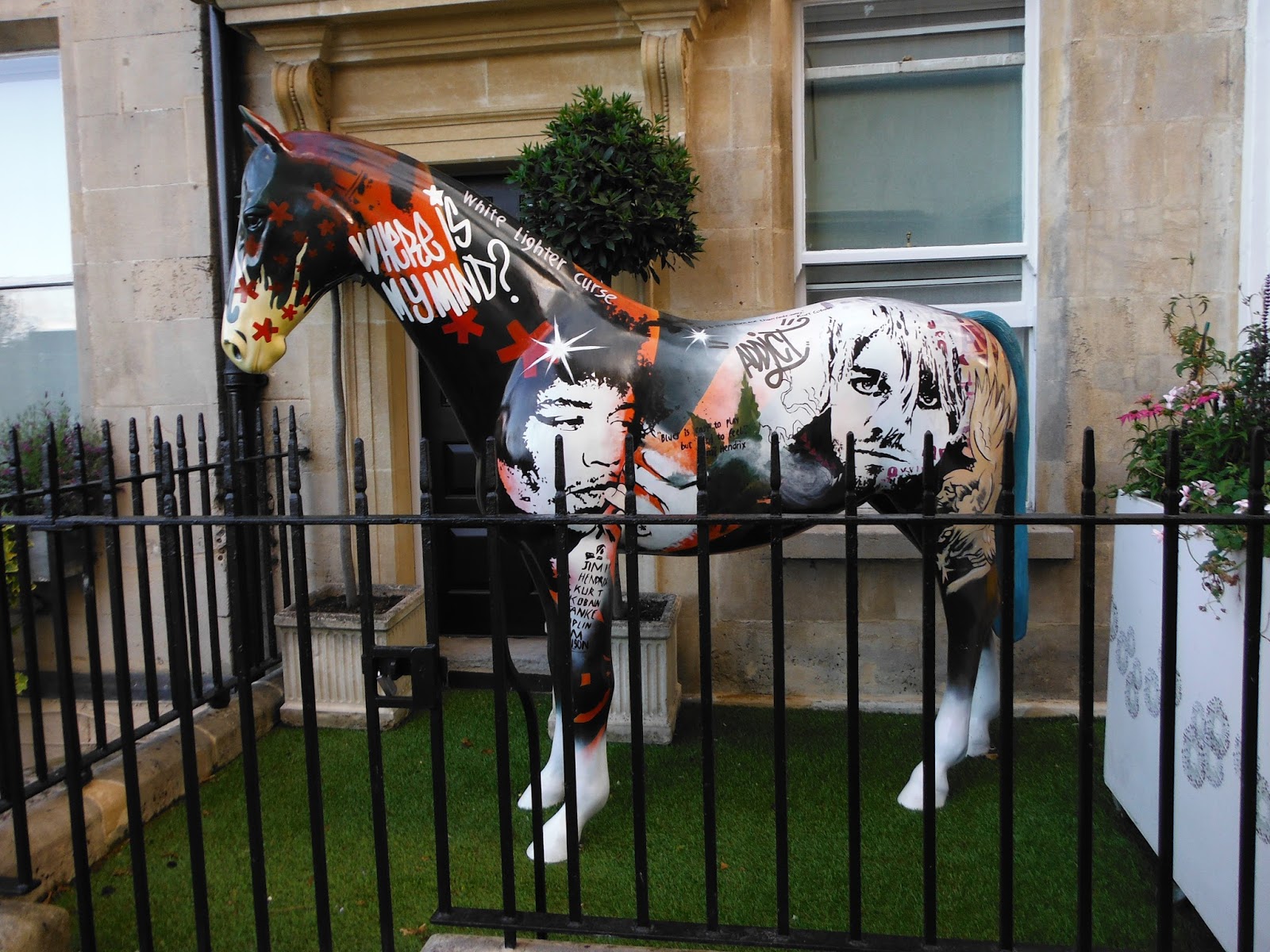


Cheerio, for now!
Annie
"To love is to act." -- Victor Hugo
Thursday, September 29, 2016
Across the U.S. in Die Frau Blue Car ("neigh!" -- Young Frankenstein reference), Part I
May all of you have a colorful and inspiring Autumn, fair readers!
On Tuesday, June 21st, I embarked upon a marvelous adventure across our beautiful country in our blue 2008 Chevy Aveo, loaded with bedding and camping gear for off-road catnaps between motel shower+bed stays. My traveling companions included a Google tablet full of audio books; a road atlas from AAA; an interstate-highway guide entitled Next Exit, that lists the amenities to be found near each off-ramp; plus a small baseball bat, a can of mace, and a key chain that screams when you pull it.
Fortunately, I had trouble with neither man nor beast on this journey. Sometimes it was too hot and muggy to sleep, but only once did the weather become a problem, when torrents of pea-sized hail fell one afternoon in New Mexico, with such density that for an hour it was impossible to see while driving. However, a spectacular sight it was, accompanied by sensational thunder and lightening! Sometimes the GPS on my tablet took me to odd places, although it saved my sanity many times on obscure country roads that lacked signage.
The first notable place that I visited was the Grand Canyon, at which I spent an inspirational afternoon. There had been some rain that day, so many of the "softer" tourists were leaving when I arrived, and I was able to spend a couple of hours on the Rim Trail without having to battle crowds. Wonderful!
Two-and-a-half days were spent in Texas, visiting the three Presidential libraries/museums there -- LBJ's and Bush 41's and 43's. The LBJ museum at UT Austin was particularly fun for me because he was president during my early childhood in the 1960s, and there were copious artifacts representing my first memories of what was on the evening news -- Kent State, Watts, Vietnam, Woodstock, etc. Bush 43's museum at Southern Methodist U. is very high-tech and interactive, much like the recent remodel of the Reagan Library. My favorite of the three is Bush 41's museum at Texas A&M, which has a very personal, home-grown feel to it, and when I visited there was a special exhibit of classic cars. The grounds near the Bush 41 museum are particularly welcoming and include a rose garden, a catch-and-release fishing pond, and a foot bridge that leads out to a peaceful gated family grave site, where their daughter, Robin, has been re-interred. One of my favorite features of the Bush 41 compound is this gorgeous sculpture of horses jumping over a piece of the Berlin Wall:

This travelogue will continue in upcoming posts, but I'd like to close this log entry with the announcement of a special project that I have begun on behalf of my family, in honor of my late mother:
The Bonnie Pryne Schaack Memorial Heritage Project
The chief aim of this project is to compile as many facts and stories about our family as possible, in order to produce electronic and printed archives for future generations of our family to explore, preserve, and append. Part of preserving our family heritage should involve maintaining sites and artifacts such as grave sites. Some of our ancestors' existing monuments are badly worn and require fresh markers. Here is the first one I wish to refresh:

This is the marker for my maternal great-grandmother's mother, Idella Butler Segondollar, who died in 1895 when she was just 23 years old, and great-grandma was only five. This grave site also contains the remains of my great-grandmother's twin brother, Henry, who died at birth in 1890. More news regarding the Heritage Project's activities will be reported on this web log, as well.
Annie
"The world is all gates, all opportunities, strings of tension waiting to be struck." -- Ralph Waldo Emerson
Subscribe to:
Posts (Atom)