Thursday, January 26, 2017

Manchester Meanderings (Sisters In Europe, Part III)

Before I begin chatting about wonderful Manchester, I must conclude my comments about Bath.  The town is blatantly tourist-y but it still has an engaging history and quite a bit of charm.  

We toured the ruins of the Roman baths, which are indeed fascinating, although they have been too adulterated (i.e., redecorated) over the years to rank high on my list of worthwhile Classical attractions.  We enjoyed the guided tour very much and took a few generous swallows of the water from the geothermal spring that still runs at the site.  I would have enjoyed bathing in the warm waters, but the bathing areas are so commercialized that we were turned off by them.  (No doubt, we are spoiled by the simple, rustic, inexpensive and/or free hot-spring pools that we enjoy in the mountains of California!)


The main pool at the Roman Baths of Bath.

I was most impressed with the gorgeous and majestic Bath Abbey.  As you can see by the photo, its Gothic architecture is marvelously intricate. My favorite artifact of Bath Abbey is the carved Jacob's Ladder flanking the doorways in the front.  So unique and engaging!


 The Bath Abbey and courtyard (above)
and Jacob's Ladder from its façade (below).

From Bath, Cynthia and I rode a train to the hard-working city of Manchester, which had been the home of our paternal grandmother, Mary Jane O'Brien. We called her Grandma Jenny.  Her parents' families were from Ireland--County Mayo and County Roscommon--but they had been in western England since the mid-19th century. Grandma Jenny was born in Manchester in 1904 and lived in the same general area until moving to America in 1920. 

One of the most striking characteristics of Manchester is its wonderful lack of tourists. Certainly, there is a lot to see in Manchester, including two major teams and stadiums for football (that's "soccer" in Yank-speak), a football museum, and of course art, history, and science museums, plus a zoo.

Cynthia and I enjoyed taking in the bustling local work-a-day color of the place. So many nice people! The joy of getting to know Manchester and its people can be somewhat illustrated by the purple, leather-jacketed, rebelliously no-nonsense character, pictured below, that appeared all over the city to advertise for a mobile-phone service.

Of course, church mice like us had to spend time exploring the beautiful neo-Gothic Manchester Cathedral, which had been damaged during the Blitz in 1940 but has been lovingly repaired, complete with a very reverent section dedicated to those who served in the war.  
Manchester Cathedral.

The grounds of the Cathedral include a lovely garden and play yard with a whimsical teeter-totter that we simply had to try out!


Our only disappointment in Manchester was learning that the archives at the beautiful Victorian Gothic John Rylands Library was not especially useful for our genealogical research, because it contained nothing that we could not access via the Family History Library in Salt Lake City, Utah. In fact, the librarians at Rylands do such research themselves through the Utah library!  Still, the Rylands Library is a lovely place, and next time I will endeavor to enjoy what it actually has, rather than grouse about what it does not have.

The Reading Room at the John Rylands Library.

Fortunately, I had collected enough advance information about our grandmother's old neighborhood that Cynthia and I were able to have a particularly good time exploring it, including a very friendly pub named Bullock Smithy(!).  Details about Grandma Jenny's life in Manchester will be the subject of a future posting.
A treasured photo of Grandma Jenny, seated on the left, and her sister Margaret, taken in 1920, the year they left England.  

The nerd in me had to visit the august University of Manchester, where there is a wonderful park-bench sculpture of the famous cryptologist Alan Turing, whose work in decoding Nazi messages was instrumental in helping the Allies win the war in Europe.  We found piles of flower bouquets on Dr. Turing's statue!  Good to see he has lots of fans, including me!  (Apologies for my squinty eyes in this photo.  My small eyes close up in bright light 😎.)

Our "recon" mission in Manchester was satisfying enough that I'm hoping to visit there again before too long, likely for more family research.  When Cynthia and I left Manchester, we hopped aboard another train bound for Edinburgh, Scotland!

Annie

"Machines take me by surprise with great frequency" -- Alan Turing.


Saturday, December 31, 2016

An Invitation to Join "2017 -- The Year of Kindness"!!!


My Dear Family and Friends:

It is my great joy to begin promoting the idea of making 2017 "The Year of Kindness."  I've been reading and hearing many in media circles discussing the phenomenon that people in America have grown so tired of mean-spirited politics and social strife, that a movement is emerging among average Americans to give deliberate acts of kindness greater-than-average importance in the coming year.  I'm all for that!  Let us all promote this Kindness Movement, beginning with our New Year's celebrations!!!

Wishing you all a very blessed 2017,

Annie

"A good deed is never lost; he who sows courtesy reaps friendship, and he who plants kindness gathers love." -- Saint Basil the Great of Caesarea

Thursday, December 22, 2016

Across the U.S. in Die Frau Blue Car, Part III

Before we all head full-on into the Christmas and New-Year holidays, here is a brief report about my visit last June to Prickett's Fort State Park in Fairmont, West Virginia.  


Captain Jacob Prickett is a direct ancestor of ours, via my mother's family.  The Pricketts were early settlers in the western frontier of Virginia that would later become the state of West Virginia.  These adventurous settlers braved harsh, rustic conditions and engaged mostly in farming and trade.  Captain Prickett served for many years with the Virginia Militia and had fought in the French and Indian War with George Washington at Fort Necessity.  As a young man, Prickett had accompanied Lawrence Washington (brother of George) in scouting local lands.  Prickett also took part in the Revolutionary War.


The cemetery at Prickett's Fort


The cemetery monument for Captain Prickett and his wife Dorothy

Captain Prickett and his two brothers had a fort constructed in 1774 near the Monongahela River as a means of sheltering his family, and the families of many neighbors, from attacks by the Shawnee and other local Indians.  The original fort no longer exists, but the fort's cemetery remains, and the site is preserved as a state park, with a model frontier fort and some wonderful living-history docents who provide explanations and demonstrations that do a wonderful job of transporting the imaginations of visitors into the rigors and dangers of frontier life.  I highly recommend a visit to Prickett's Fort State Park to anyone who finds themselves in West Virginia!


 Some views of the model fort
 from the website of
the Prickett's Fort Memorial Foundation

 Some dedicated living-history docents
 at Prickett's Fort

The visitor's center at the fort has a wonderful library, and the staff allowed me to comb through some of its books and take notes for my genealogical studies.  I'm looking forward to return visits to this wonderful site, hopefully accompanied by family members! 

Annie

"Christmas is a season not only of rejoicing but of reflection." -- Winston Churchill

Friday, November 18, 2016

Book Review -- "Walking to Canterbury" by Jerry Ellis.

While on our annual family outing in the Eastern Sierras for Aida's birthday, during which we inhabited a cabin at Virginia Lakes that is owned by some very kind friends, my sister-in-law Lisa and I were so exhilarated by the local trails that we decided we would like to take a trip to Britain next year to go walk-a-bout.  Combing the San Francisco Main Library for books to help us plan such UK outing, I happened upon a book in the travel-writing section with an intriguing title -- "Walking to Canterbury: A Modern Journey Through Chaucer's Medieval England." The title piqued my interest, as it seemed likely that the book's contents would provide a few ideas for our own trek.  More than just ideas, this book provided ample inspiration!

Author Jerry Ellis is well known for taking very long walks and then writing beautifully about them.  He explains in "Walking to Canterbury" that he has ancestral roots in the British Isles and also some Cherokee blood.  Ellis had previously undertaken a journey across the Trail of Tears, that had been the route of the forced Cherokee exodus from their homeland at the direction of our government in the 1830s.  He had written about this extensive hike in his celebrated book entitled "Walking the Trail" (which is now on my reading list). Ellis felt behooved to embark upon a pilgrimage in the UK that would in some ways mirror his expedition in honor of the Cherokee.

Ellis recounts his experiences as he walked along the medieval Pilgrim's Way to Canterbury, which he began not far outside London and concluded about a week later at Canterbury Cathedral, the site of the brutal murder/martyrdom of Thomas Becket.  He alternates his physical and spiritual adventures along the trail with fascinating studies, both of life in medieval England and the troubled pilgrims described in Chaucer's Canterbury Tales.  Ellis finds himself sympathizing, and sometimes identifying, with the medieval pilgrims, and he describes his strong, reliant affection for the colorful characters with whom he interacts during his week in 1999 England.

In the book's Epilogue, Ellis offers some of the perspective to be gained from a look back at medieval Britain:  "While the medieval church may have controlled the ignorant masses, the modern American world is also a bit brainwashed.  But instead of the church doing it on the great scale it once celebrated, it has been replaced with advertisements on TV: every other ad caters to people's fear of death, just as profound now as it was in the Middle Ages.  But instead of taking pilgrimages for our spiritual and physical health, we have turned to 'miracles' in the form of every pill imaginable.  Don't forget to buy that new car, the latest fashion, and diet food--guaranteed to give heaven on earth."

"Walking to Canterbury" is an engrossing book for anyone who enjoys purposeful, explorational walks that immerse the sojourner in nature, history, and culture as well as provide encounters with interesting people.  Ellis' approach to his own genealogical background has provided inspiration for my own efforts at compiling family history, and I believe others who have ancestral roots in Britain will find this book valuable. Ellis has likely motivated many of his readers to undertake at least small sections of the walks about which he has written, particularly this one in England because the UK government marks and preserves the trail.

The modern official British National Trail name for the Pilgrim's Way described by Chaucer is the North Downs Way.  Sections of the original trail are no longer accessible, but North Downs retraces as much of the medieval route as possible, and locals still call it Pilgrim's Way.  

A very blessed Thanksgiving to you all!  May you feast upon the warmth of family and drink deeply of the knowledge that they love you as you are!!

Annie

"Just as our forefathers came to America to seek a better life, I grasped more clearly in digesting my trek to Canterbury that we are still searching for meaning and purpose in a complex and constantly changing society." -- Jerry Ellis


Wednesday, November 16, 2016

A Quick Request From A Simple Patriot.

Dear Friends, 

More than a week has passed.

Although I acknowledge that the freedom to wage protest is sacred to all patriotic Americans, I feel the current crop of discontents who rail over the election of Trump to the presidency is not allowing themselves to appreciate an essential element of the American public arena -- the sheer power that is manifest by means of the constant atmosphere of rivalry that fills the lungs of every thinking American.

This rivalry has kept our brains oxygenated since our days as colonial subjects. This element of the American mind has changed little over three centuries, save for the fluctuations of contemporary circumstances. The genius of the very Constitution by which we govern ourselves is that it is, itself, the product of profound disagreement. 

Every election, especially the federal ones, are a toss of the coin of public opinion. Particularly in the cases of the presidency and the partisan makeup of Congress, the heads and tails of this coin have taken fairly even turns throughout our history. If one side gives in to histrionics when the other side wins, they are cheating themselves of the comfort they should take in the likelihood that the next coin toss will favor their side.

This back-and-forth lob of primacy in our political structure keeps everyone in the game, always training for the next contest. If you must cry over a loss, make it a brief sniffle, then get back to work.

God bless America!

Annie

"I never considered a difference of opinion in politics, in religion, in philosophy, as cause for withdrawing from a friend." -- Thomas Jefferson


Monday, November 7, 2016

Across the U.S. in Die Frau Blue Car, Part II


Hello, everyone!  

Just got released from jury duty -- again!  Is it possible I have inherited my mother's unacceptability for juries?  Over and over, she was rejected to serve on juries because the attorneys thought she would be biased, due to the fact that she was a mother (the "lioness" type) and a working woman (the "no-nonsense" type).  Was she really biased?  Probably!  But still she would have tried to be fair.  Oh, well, they will keep calling me up, so perhaps I'll get my chance.

When last I was recounting my Summer vehicular sojourn, I was departing Texas and heading to New Orleans.  I hadn't been there for several years, since before Hurricane Katrina.  As a fan of traditional jazz music and of southern culture in general, I made it a point to spend a day in Nola.  The strong French background in my family leads me to enjoy the Francophile vibe in Louisiana, although the French who settled there were mostly Catholic, while we are descended from persecuted Huguenot Protestants.  

Regardless, I don't believe my Huguenot ancestors would have minded that I made my usual stop in Saint Louis Cathedral to take a look at their gorgeous ceiling.

For the first time, I wandered a over to the Old Ursuline Convent for a tour of its French Colonial building and gardens.  The Ursuline nuns have had a presence in New Orleans since the 18th Century, caring for the poor and educating local girls.  Their chapel has a serene feel with lots of lovely art.


New Orleans is one of the few places where I will enthusiastically stop and listen to street musicians and put more than just pocket change into their instrument cases.  These are not your typical buskers!  Some of the most soulful jazz you will hear is played outside of the clubs, in the open air, in New Orleans.  My meanderings around the French Quarter on this trip were, as usual, a treat for the ears!

Oh, yes, and a treat for the taste buds!  Can't visit Nola and not indulge in some seafood (this time, yummy catfish) and beignets from Café Du Monde (Marty made me promise to have one for him)!


À bientôt, Mes Amis!

Annie

“Always vote for principle, though you may vote alone, and you may cherish the sweetest reflection that your vote is never lost.” – John Quincy Adams


Tuesday, October 18, 2016

Friendly Hostelling in the UK (Sisters In Europe, Part II)

Hope you are all enjoying the cooler, yet cozier, days of Autumn!  If you have never before traveled to Europe, may I recommend that you make your first trip there in the Autumn?  My first journey to England was taken during a September in the late 1980s, and I was treated to minimal rain and relatively small crowds at even the most popular sites. The Spring is nice, too, but you are more likely to have a wet (albeit still pleasant) visit during those months.

Another recommendation I like to make for travel, particularly in Europe, is to try staying in hostels.  You can check out websites such as hostelworld.com (the one I use most often) and try to find hostels with guest reviews that are mostly positive.  As a bonus, many hostels add considerable local character to your visit.  Many believe that hostels are only for young singles or backpackers, but I have seen more and more middle-aged and retired folks enjoying the communal vibe of hostels in recent years (we Boomers have not lost our sense of adventure, you know!).  If you are not jazzed by the idea of sleeping in a dormitory with 20-year-olds, you can find a good many very nice private and double rooms in hostels, and you won't always have to share a community bathroom.  

My sister Cynthia is an immensely social person, so I booked us almost exclusively in hostels for our European explorations.  For the most part, we found our hostel stays to be quite pleasant, with friendly staff and guests.  Frankly, I have had more bad experiences with hotels over the years than I have had staying in hostels, so I remain confident in recommending them.  Another bonus with hostels is they are usually much freer with advice and ideas for local exploration.  Only once have I been steered into the wrong direction by a hostel (more about that when I tell you about our adventures in Rome).

For our initial stop in London, I introduced Cynthia to the full-on experience of hostelling by booking space in a 10-bed dormitory at Clink-261 near Kings Cross Station.  Previously, I had had a pleasant stay in the same hostel back when it was named Ashlee House, and their redux is a nice modernization.  Here is a pic of the room in which we slept:
As you can see, the room is clean with security cameras.  Clink-261 also has smaller, less populated rooms, of course, along with free lockers, fresh towels, simple breakfast (toast, cereal, etc.), and a full kitchen for use by guests.

From London, we journeyed northward by taking a nice, comfy bus to the historic hot-spring-spa city of Bath, which is famous for its Roman bath ruins.  The original Roman bath has been tinkered with by British visitors over the years, but much of the original structures remain, and you can still drink water from the hot spring (and we did!).  

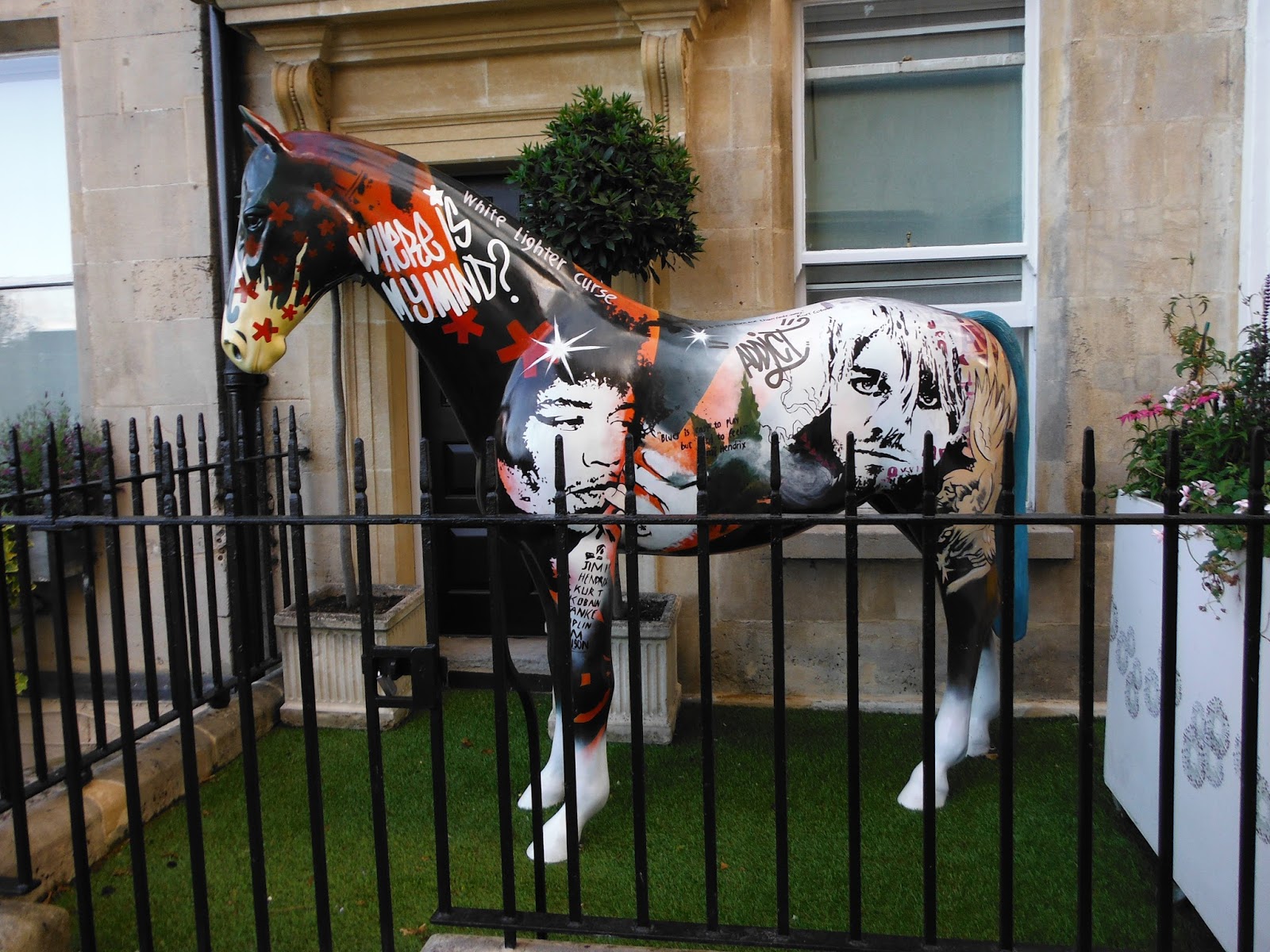
I don't take many "touristy" photographs, preferring to take photos of the whimsical and artful objects I encounter.  Here are a painted horse and a mosaic pig we found in Bath:


Cynthia and I enjoyed very much the friendly YMCA hostel in Bath, which I recommend highly for inexpensive, comfy lodging:
From Bath, Cynthia and I boarded a train to Manchester, where our paternal grandmother was born.  Manchester remains an industrial city full of hard-working people from all over Europe and beyond.  My next Europe-related post will provide a report about our experiences in Manchester and the suburb in which our grandmother was raised, Hazel Grove.

Cheerio, for now!

Annie

"To love is to act." -- Victor Hugo